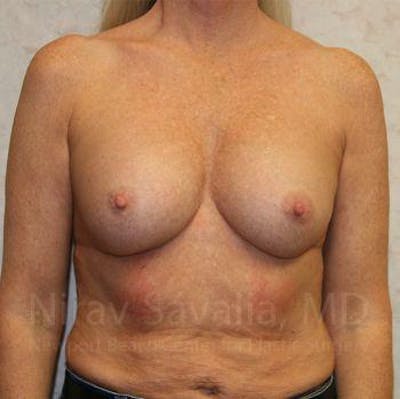
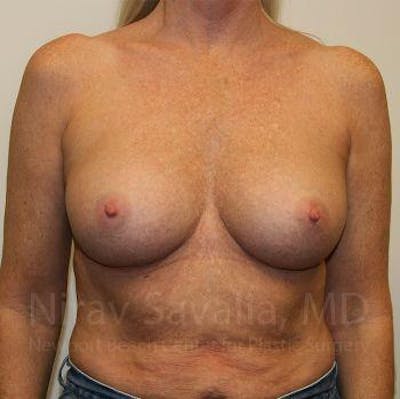
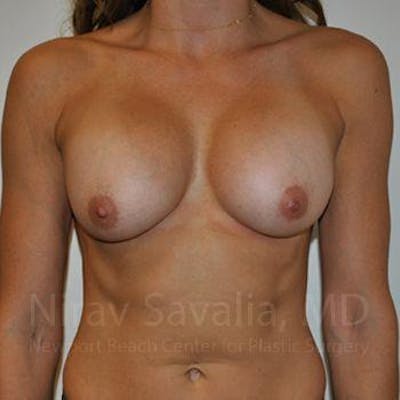
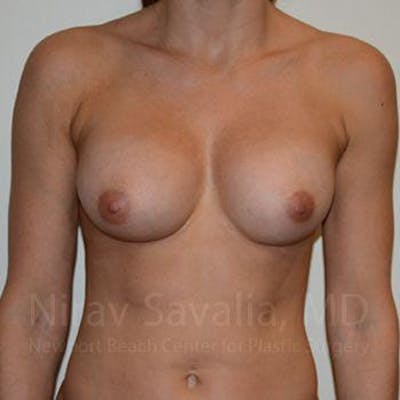
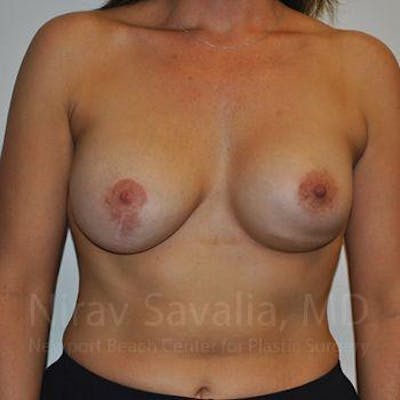
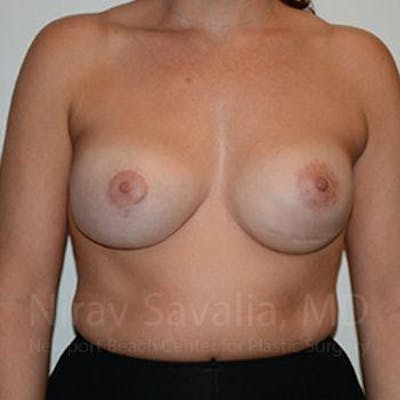
Common Reasons for Breast Revision Surgery
Capsular Contracture
Capsular contracture occurs when the capsule (natural scar tissue that forms around a breast implant) becomes unusually thick, tight, or constricting. This often causes the breasts to feel firm or painful, or look distorted or unnaturally round.
Dr. Savalia usually recommends total capsulectomy for capsular contracture correction. This way, the abnormal capsule is removed completely rather than simply released. A thorough approach helps to improve the shape and feel of the breasts while reducing the risk of recurrence.
Bottoming Out
Bottoming out happens when an implant drops too low on the chest, usually below the natural breast crease, causing the nipple to appear too high on the breast mound. This can create an unnatural, stretched appearance and loss of fullness in the upper breast.
Correction often involves tightening or rebuilding the implant pocket, reinforcing the lower breast fold, and, sometimes, a breast lift.
Implant Position Issues
Some implants sit too high, too low, too far apart, or too close together. Implant malposition can happen over time or can result from the original breast augmentation surgery.
Dr. Savalia will carefully evaluate the implant pocket and may adjust implant placement, reinforce weak tissue, or change the implant plane from over the muscle to under the muscle for better long-term support.
Double Bubble Deformity
A double bubble occurs when the implant sits below the natural breast crease, creating the appearance of two stacked breast folds, or a “double bubble.”
Correction requires surgical revision of the breast pocket to reconstruct the inframammary crease.
Anatomical Implant Concerns
Teardrop-shaped anatomical implants can sometimes rotate out of place, making the breasts appear misshapen and asymmetrical.
Revision surgery can involve replacing anatomical implants with round implants or otherwise reshaping the breast pocket to prevent shifting in the future.
Ruptured Implants / Leaking Implants
Breast implant rupture can occur with both saline and silicone implants. Saline ruptures are immediately noticeable because the saltwater solution is safely absorbed into the body, and the implant visibly deflates. Silicone ruptures, on the other hand, are often called silent ruptures because they can typically only be detected with MRI or ultrasound.
Dr. Savalia carefully evaluates implant integrity during implant replacement after rupture, also addressing any concerns about the surrounding scar tissue.
Symmastia
Symmastia is when implants are too close together, causing loss of separation between the breasts. This creates the appearance of implants merging over the breastbone in the center of the chest.
Correction requires delicate reconstruction of the cleavage space and implant pockets to restore proper breast positioning.
Asymmetry Correction
Differences in breast shape, size, or nipple position can be present before breast augmentation or develop over time after breast augmentation.
Breast revision can improve symmetry through various methods, including implant exchange, pocket revision, breast lifting, fat grafting, or a combination of techniques to create a more balanced appearance.
Implant Size Change
Sometimes your aesthetic goals change. You may wish to go larger for more fullness, or smaller for a lighter feel and more natural appearance.
Breast revision allows you to exchange implants for a size and type that better suits your body, lifestyle, and aesthetic preferences.